

FAIRSHARE
At Finca Las Hormigas, we believe that true regeneration is born from a deep connection with the local ecosystems, and from honoring those who inhabit it. From our agricultural practices to the way we welcome visitors, we live the ethics of permaculture: care for the earth, care for people, and share the surplus.
Our commitment is expressed through projects, alliances, and concrete actions that seek to generate positive, lasting, and shared impact.

ASOGUABO
Website: https://asoguabo.org/
We are members of ASOGUABO, the Association of Guardians of the Caribbean South Forest. This organization brings together farms, initiatives, and projects committed to conservation, ecological restoration, and protection of the territory. Through this alliance, we participate in collaborative spaces, environmental education, and the creation of responsible tourism models to strengthen conservation in the Talamanca region.
THIS IS HOW WE TAKE CARE OF THE PEOPLE, THE EARTH AND FAIRSHARE IN OUR LOCAL COMMUNITY:
SUPPORT FOR THE LOCAL ECONOMY
What we do not grow on the farm, we intentionally purchase from small family businesses in nearby communities. By sourcing fruits, vegetables, bread, materials, and services from local entrepreneurs, we keep resources circulating within the territory and support the families who depend on these incomes.
Our relationships are personal, long-term, and rooted in reciprocity. Every purchase strengthens a livelihood and reinforces the resilience of our shared ecosystem.
We also collaborate with neighboring businesses by collecting their organic byproducts, like sawdust, coconut shells, and wood scraps, and transforming them into mulch, biochar, and other resources that regenerate our soil. This helps us close loops, reduce waste, and create value together.
DAIRY AND EGGS COME FROM ADRIAN AND MARITZA
We source fresh milk, eggs, and handmade cheese from Adrian and Maritza, local neighbors who milk their cows and make cheese entirely by hand. They also provide us with ashes from their wood-fired kitchen, which we use in various farm applications. We also help clean their chicken coop and exchange work for gallinaza, fostering a supportive relationship.


FRESH COCONUTS FROM ANASTASIO
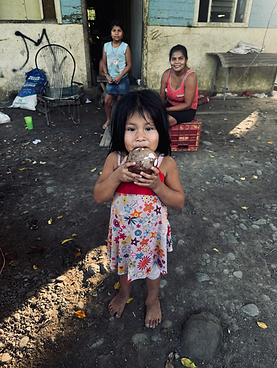
We buy fresh coconuts from our neighbor Anastasio, a family-run business where coconuts are peeled by hand using traditional tools. Along with the coconuts, he shares the husks left over from each harvest. These husks are essential to our soil protection systems, helping retain moisture, build organic matter, and protect garden beds. In this way, a simple local product becomes an integral part of our ecological restoration practices.


SAWDUST AND SCRAP WOOD FROM PLATANERA SIXAOLA
From Platanera Sixaola in Bribri, an organic banana plantation, we receive sawdust for our plantings and discarded wood from their pallet production. Instead of going to waste, this material becomes a valuable resource on the farm: we transform the wood into biochar and use the sawdust to improve soil structure and moisture retention. This partnership allows us to repurpose waste into regenerative inputs.
COMMUNAL BONDS WITH OUR NEIGHBORS
THE TORRES FAMILY: A RELATIONSHIP ROOTED IN DECADES OF HISTORY
Our connection with Don Eliezer and his family is one of the deepest bonds we have in the territory. They are from the town of El Parque and have been linked to this land long before Finca Las Hormigas existed. For more than 30 years, Don Eliezer worked on the farm, and over time we have provided steady employment to all his children.
Antonio, who even lived on the farm for a period, continues to work with us today. Jordan and Memo, who are part of our current maintenance team, also belong to this extended family. These relationships are not recent collaborations but long-standing ties built through trust, shared history, and genuine community support. The Torres family forms an important part of the roots and identity of this place.
SUPPORT FOR THE COMMUNITY OF EL PARQUE
Our ties with the town of El Parque expand beyond families. We collaborate in local projects that improve the quality of life of the community. One of the most notable initiatives is the new synthetic-grass soccer field, a space that has become a sports and social hub for the area.
Finca Las Hormigas was one of the official donors of this project, alongside BAC and an international funding program. Our contribution was recognized publicly, and we are proud to support a facility that brings health, recreation, and unity to the families of El Parque.
PARTNERSHIP WITH THE TECHNICAL SCHOOL OF BRIBRI
We maintain an ongoing educational partnership with the Technical School of Bribri, creating opportunities for students to gain hands-on experience in regenerative agriculture and land stewardship.
Each year, the school sends students in their penultimate and final year to complete internships on the farm. The first internship lasts two weeks, while the second extends for two to three months. Over the last two years, we have welcomed around twelve students who come to apply what they have learned in class and deepen their technical knowledge through practical, real-world work.
This exchange strengthens local education, supports the development of young professionals, and reinforces the connection between Finca Las Hormigas and the wider Bribri community.
COLLABORATION WITH CACAO TSIRUSHKA
https://www.instagram.com/cacaotsirushka/
Our relationship with the Bribri Indigenous people is an important part of our local connection. Today, we serve as a bridge, connecting people from the farm with Rosa and Antony so they can learn about Bribri cacao wisdom and participate in their traditional circles. These ceremonies honor the land and open a space for sharing ancestral knowledge, stories, and cultural memory. All contributions from these cacao circles are paid directly to the Bribri community, supporting their work, their traditions, and their role as cultural guardians.
During the cacao circles, Rosa and Anthony, a couple chosen by their clans to represent their people, teach about Bribri history, including the impacts of Spanish colonization and the meaning of the ancestral relationship that continues today between the Bribris and the sìwas (non-Bribris). For them, sharing this history is essential, as many of these stories risk being forgotten over time. We want to see their voices being respected, compensated, and amplified.
PAST PROJECTS AND COLLABORATIONS:


El Barro Vuelve
https://www.instagram.com/elbarrovuelve
The relationship with El Barro Vuelve was born from a friendship nurtured through community work, exploration, and experimentation with clay. Together, we hosted ceramic retreats that integrated local clay and ancestral techniques, creating gatherings that strengthened creativity, human bonds, and a connection with the land.
GIVE Volunteers
https://www.givevolunteers.org/
We collaborated with GIVE to create regenerative tourism experiences that combined learning, community impact, and cultural connection. Together with their team, we designed activities that integrated sustainable practices, conservation projects, and support for local initiatives. This partnership amplified our impact and allowed young people from around the world to take part in real regenerative processes on the ground.

Raleigh International
https://raleighinternational.org/
Together with Raleigh, we hosted groups seeking meaningful volunteer experiences and sustainability education. We created educational programs that combined farm work, environmental projects, and community activities. Our collaboration promoted youth leadership, ecological awareness, and service to the territory.
EL BARRO VUELVE & FINCA LAS HORMIGAS & THE BRIBRI COMMUNITY:
CULTURE AND COMMUNITY IN REGENERATION
El Barro Vuelve is a cultural regenerative initiative that creates a bridge between Finca Las Hormigas and the Indigenous communities of Boca Uren. Through this collaboration, we support the revitalization of ancestral Bribri ceramic traditions, an art form that has been fading with time.
Working together with Rosa and Anthony, who serve as the community’s appointed bridge between the mountain people and the outside world, this project brings together women from various Bribri towns four times a year. Guided by Ana from Barro Vuelve, these gatherings offer classes, tools, and access to a traditional kiln so participants can remember the ancient craft of ceramic-making.
This project not only preserves cultural heritage but also creates new income opportunities for Indigenous women. By recovering ancestral knowledge and offering resources for production, El Barro Vuelve strengthens autonomy, creativity, and economic resilience within the community.
Our role at Finca Las Hormigas is to support and accompany these efforts, always under the guidance and leadership of the Bribri families themselves. Through this three-way collaboration between El Barro Vuelve, the Bribri community of Boca Uren, and our farm, we help sustain a living network of cultural regeneration, solidarity, and shared purpose.


